
Olivier Cresp
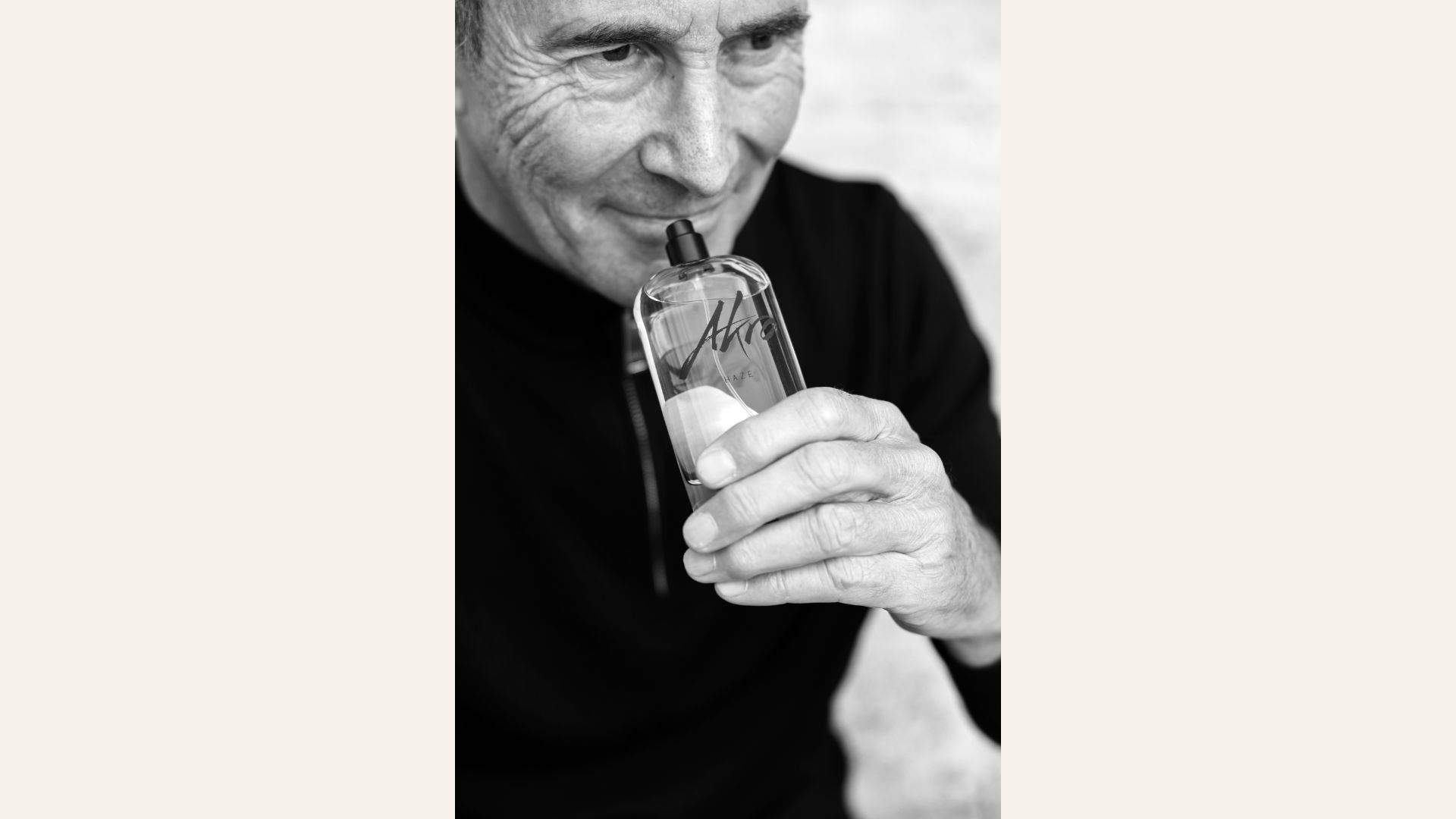
Olivier Cresp is one of the world’s most renowned perfumers, and each time we meet, we learn so much. Recently Olivier was back in London to talk us through his own, expanding AKRO fragrance brand – the name means ‘addiction’, in French – which he creates for, alongside role as Master Perfumer at global fragrance house dsm-firmenich.
One of the perfumery world’s most distinguished figures, Olivier Cresp has almost certainly composed some of your favourite creations, since his c.v. includes Dior Midnight Poison, Penhaligon’s Juniper Sling, Dolce & Gabbana Light Blue, Givenchy Gentleman – and, of course, the legendary Thierry Mugler Angel, which not only brought Olivier instant fame, but created the entire gourmand category. Olivier joined the dsm-firmenich team in 1992, was elevated to Master Perfumer in 2006, and was honored with the title Chevalier des Arts et des Lettres from the French Ministry of Culture in 2012 (essentially, France’s equivalent of a knighthood). AKRO, meanwhile, was launched in partnership with Olivier’s daughter Anais, who happens to be based in the UK. .
When does your day start?
I like to play tennis in the morning, then go to the beach in the afternoon… [laughs] No, seriously, I never really feel like I’m working because it’s my passion. That’s why I’m still working within dsm-firmenich, as well as on my own projects with AKRO – which is pure pleasure because we have no limits; we can dare. On a normal day, I get to the office around 9.30. The first thing I always do is talk to the other perfumers – ask how their evening was, have a coffee. Around 9.45 or 10am I open my laptop and start working.
Where do you work?
I have a double job, working for dsm-firmenich as Master Perfumer, based in Paris, and working for my own house, AKRO. I have assistants, FDMs (Fragrance Development Managers), sales teams, managers, any number of colleagues depending on the project.
How does your day break down?
My office is open plan, so I have the FDMs come to see me, followed by the evaluators and the salespeople. After that, customers call me. An innovation is the number of Zoom and Teams meetings we do throughout the day – a few years ago this just didn’t happen, but now we spend much more time talking to colleagues online.
In the afternoons, I spend time at the AKRO offices, and then go back to dsm-firmenich for an hour, an hour and a half. Equally, I can also work from my flat, from Normandy, Cannes. The pandemic changed a lot of habits and nowadays a lot of people work from home.
How many fragrances might you be working on at one time?
When everything was done by hand, I could only work on eight or 10 fragrances a day. Now, with computer technology, I can send 50 formulas a day, sending them all over the world. There are perhaps 20 projects I’m working on at once, sometimes more. I prioritise the fragrances by dates and even hours for deadlines. I can be fast. You have to be! Depending on how quick you are, you can win or lose a project. To work fast you must have the experience and use your time well. Instead of doing hundreds of experiments, like I did at the beginning of my career, I now only need to do four or five – then I know exactly what to move in my fragrance formulas and it just works.
“‘With computer technology, I can send 50 formulas a day, sending them all over the world.’”
How do you work?
Perfumers are like writers; some prefer handwriting or dictating, others like writing straight on a computer. 30 years ago, I used to do everything by hand and my calculator. I’d handwrite the ingredients and work out the percentages and price for them. Those days are long gone. Now we have special programmes that work those bits out for you. When I’ve written my formula on my laptop I send it straight to the robot, the robot compounds about 80% of the formula. Then I have my assistants who weigh and compound the missing 20%.
As soon as I get the idea for my fragrances, I know exactly what ingredients I want to use. For instance, with AKRO Heat, I wanted a burning effect, a sensation of warmth. I used cinnamon, cardamom, nutmeg and ginger, juniper… and pimento. I like to play with the sense of temperature, in a fragrance; Breathe is the opposite – it uses molecules which are super-cool.
Do you break for lunch?
I like to meet colleagues for lunch. We always go out, because there’s no canteen or anywhere you can get food in the office. Perhaps a few times a year if I’m in a hurry I grab a snack and eat that at my desk, but I hate it. I also have the possibility of going to my house for lunch, because it isn’t far away. I might walk there and stay an hour, make myself some nice food, have a change of scenery, then I come back and feel revived by that.
What will the afternoon be spent on?
I always feel more energetic in the afternoons than I do in the mornings – probably helped by the lunch, inspirational conversations with colleagues and simply the change of scenery – so I feel I can tackle more difficult things then.
When does the working day end, for you?
In the past I used to stay until 9pm, working at least twelve hours a day, but I don’t do that any longer. Now I stay in the office until around 7.30pm, then I go back to my house and do some sport. I never work at home, not ever, otherwise my head would explode. Well, OK, sometimes I take my laptop and work from home, but on these occasions generally I’m with my wife, and we’ll stay maybe a week in Paris and a week in the South of France, where we have a nice flat. Seeing the sea, the luminosity of the area, being in Cannes, visiting the islands, the harbour, watching the boats coming in and out, gives me such inspiration. My nose doesn’t switch ‘off’ as such, but we’re not going around smelling things all the time as a perfumer, not in the same way as when we work, I think it would be impossible to have a life.
What kind of other inspirations do you look for, during your day?
I can be inspired by anything, but conversation is really important to me. I buy loads of magazines on all subjects; I enjoy reading Le Figaro, but I get lots of women’s magazines, too. I also love walking, being in the forest, foraging, fishing, smelling the seaweed. I always carry blotters with me, so during the day I tend to jot down ideas on those, just in a few words.
“‘I need to feel energised, to create I must feel passionate about what I’m doing because otherwise what’s the point?’”
Do you have to be in a particular mood to create?
I need to feel energised. I must feel passionate about what I’m doing because otherwise what’s the point?
How long does it take from concept to finished fragrance, in general?
My initial concept can be done in two or three hours, but how long it then takes to come out as a finished fragrance might be two or three years! Ideally, a year and a half is enough to create a great fragrance, then you have to wait until the year after that to be on the market.
Is a visual moodboard helpful for you to create?
More and more clients send me pictures to look through. Before, I’d be sent a few piles of pictures a year, in hard copy. Now it’s mainly digital they can easily create a moodboard; it’s a visual language. To see on the screen what they want is useful. But often they can turn out the same. You know: it has to be strong but easy to wear, pleasing to the market, something different, long lasting, another unique fragrance… When I’m gathering inspiration for myself, I flick through magazines; it takes about ten minutes to get an overview and see the colours – colours really drive me. I like to keep my eye in, see what people are interested in. Sometimes I then see these images again in moodboards that clients then send me, because they often use images they’ve found in magazines, so I like to know the context. Sometimes the inspiration they send is really good, it helps give me ideas more quickly.
What is the most number of modifications you’ve ever had to do, on a fragrance? And the least?
Some just happen really quickly. Dolce & Gabbana Light Blue, for example, I did in 40 trials, but I have some that are painful – the longer you’re working on something I feel it’s the worst for creativity because you can get lost. I’m lost, the client is lost. The entire concept can change, the name, if it’s feminine or masculine in style, literally everything.
How many materials do you have at your fingertips, to work with?
Out of 1500 main ingredients I have access to – what we call a ‘living palette’, which can always be added to – I’m usually working with the same 400. This means I don’t have to smell them all the time, which might sound strange to some people, but I know them so well I know all the outcomes and possibilities of them. It takes you 10 years to get to know them that well – to see, to feel, to touch, then just to know.
How much of your time is spent on your own creations – new accords, etc.?
I don’t have that time, generally. The only trésor time I have, to do exactly what I want, is with AKRO. The thing is, I don’t need to actually smell materials all day, to write a formula. I will only then smell them to create a big step in that formula or change it somehow. When we get new molecules or ingredients and extractions to smell, that is always exciting, because I don’t know them!
What is the one fragrance you wish you had created?
Guerlain Shalimar. It’s what I’ve smelled in my family for years, I love the richness of the bergamot with the leather and vanilla, the benzoin. It’s magic! I created Champs-Elysées for Guerlain – with musk, mimosa, you know, very different; I loved it but it didn’t go so well. Still, I created for Guerlain, and it was a great time. For a masculine, meanwhile, I’d loved to have created Dior Sauvage. Another all-time classic. What more can you ask for?
AKRO fragrances are priced £160 for 100ml eau de parfum; the AKRO Discover Set of 10 × 2ml eau de parfum is priced £39 here