
Aurélien Guichard
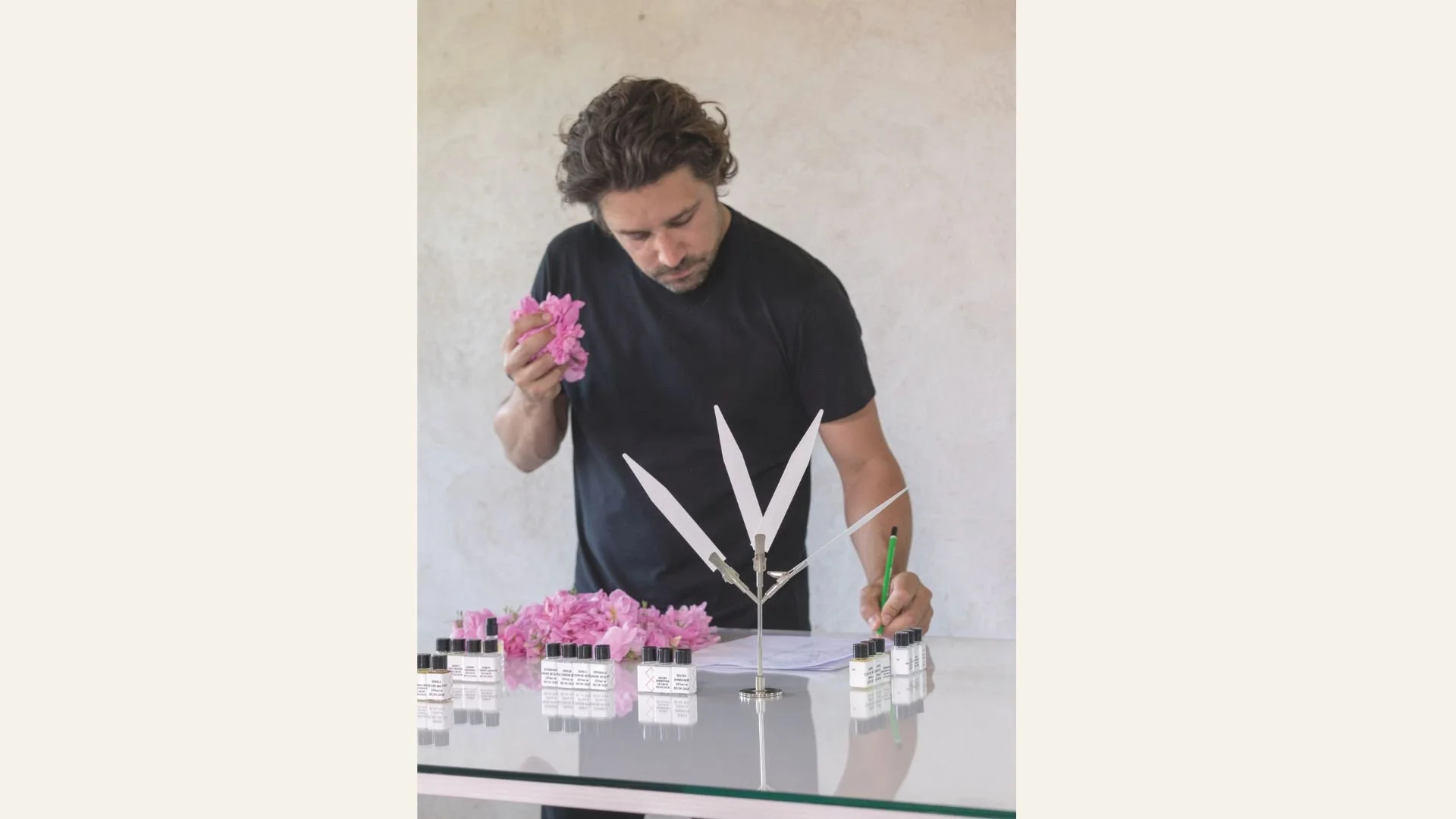
Born to a fragrance dynasty, following his destiny to become a perfumer, and composing fragrances in a workshop in the middle of his own flower farm: Aurélien Guichard’s life sounds like a dream. We talked to him about his fragrant reality, his working day and his inspirations
When your grandparents supplied rose and jasmine to the fragrance industry, your father is perfumer Jean Guichard (creator of legendary scents such as Calvin Klein Obsession, LouLou and Eden for Cacharel, not to mention Hermès Concentré d’Orange Verte), and you’re raised in Grasse – the tiny town that’s still the epicentre of perfumery – surely fate has decreed a life in fragrance?
Training at Givaudan’s school of perfumery, working for them until moving to the fragrance houses Firmenich and then Takasago, Aurélien has followed his fragrant bloodline. He is the nose behind such giants as Gucci Guilty and Versace Eros, and has composed for a plethora of perfume names – from Bond No.9, Burberry and Narciso Rodriguez to Robert Piguet and Paco Rabanne.
“‘I know what it will smell like before I begin, in my head, but it’s all about that observation, turning a concept into a living perfume’”
Today, Aurélien Guichard has his own fragrance house, MATIÈRE PREMIÈRE, with fragrances built around a single ingredient; Radical Rose was winner of the The Fragrance Foundation UK Perfume Extraordinaire Award in 2021. Uniquely, the brand is based out of his own fields of rose and tuberose, in the South of France.
How does your day start?
The beauty of this job, for me, is that I never have the same day. I know some people work to a routine, but I really don’t!
Where do you work?
I live in central Paris, and my lab there looks very futuristic, everything is white, very scientific. But the second place I work from is a creative hub in the middle of my own fields, which I use for MATIÈRE PREMIÈRE. It’s a place I share with my mother, who’s also an artist (a sculptor), and I work very close to nature and the materials I use.
How does your day break down?
I like to start from scratch. In the morning, I usually smell some modifications I’ve made the day before, because I have a fresh nose and a fresh vibe. Then I’ll either make modifications based on the existing formula or start something new. As the day goes along, I’ll smell further modifications made by my lab assistant. I write the formula; he makes it up and compounds it. It’s a lot about waking up in the morning with one idea in mind.
How many fragrances might you be working on at one time?
When I was learning perfumery, much of it is about observing raw ingredients – how does it react with another, how does it smell on its own? This stage is very much linked to my creative process, still. So today, I can be working on several projects at once, all at differing stages.
How do you compose?
I know what it will smell like before I begin, in my head, but it’s all about that observation, turning a concept into a living perfume. It always begins with the finding the right ingredient. If I’m working on a patchouli, for example, I must smell many different examples from all over; they each have unique qualities, so it’s about finding the right one for that fragrance, which then works in harmony with the surrounding ingredients.
Some people like to use notes that almost fight with each other and cause a tension, but for me with Matière Premiere it’s all about coherence. You know, I think anyone could be a perfumer. Of course, you have to learn, but anyone can have great ideas. My teacher at perfumery school used to tell me, the more you know the techniques, the freer you are to express your ideas. The question then is how good you are at expressing that idea into a workable perfume.
Where do you draw your inspiration?
A lot of it comes from being in my atelier in the middle of those flower fields! It’s such a privilege. What I’m really inspired by, in a very humble way, is the belief in the creation, that when you start everything from a white page, anything is possible. My father, who was a perfumer, told me this: to hold on to the excitement of making something that isn’t only beautiful, but is unique and interesting.
When I’m working for another brand, I also like going into stores and meeting people who wear their perfumes, I try to understand people, what they are looking for. With Matière Première it’s very different: I’m mainly inspired by the raw materials – I’m not working to a brief, I can use whatever I want, explore differing facets of an ingredient I love. My favourite thing is to be surrounded by people from different backgrounds. When I’m in the south of France, I have friends come and stop by who are all kinds of artists and sculptors, or some will work in a bank, and that mix of energies gives me ideas.
Do you break for lunch?
“‘My teacher at perfumery school used to tell me, the more you know the techniques, the freer you are to express your ideas’”
I often forget the time and just keep working. If I’m in an office with other people, of course we can’t bring other food and smells in there, so at lunchtime when they leave, I like to get out and spend time in an environment where it’s relaxed, where I can also ask normal people their opinions about what I’m working on.
When does the working day end, for you?
It depends how it’s going, but when I finish my day, I usually get together my best modifications, and apply one or two on my skin to spend the evening with. If a fragrance doesn’t wake me up, it means it doesn’t have enough diffusion! I’d say a lot of my work is about trying to make something that’s nice to wear in the evenings.
Do you need to be in a particular mood to create?
I can’t create a fragrance if I’m in a bad mood. If that happens, I go away and do some more admin, or maybe I’ll go for a drink with a friend. To me, there has to be a sense of pleasure, of feeling in balance with yourself, to be able to create.
How long does it take you from concept to finished fragrance, in general?
Sometimes I will be capable of creating a perfume in 10 or 20 tries – by that I mean modifications of the formula I began with. But it really depends on the individual project. If it’s for a brand, I’m lucky enough to be able to choose who I want to work for, and they’re usually super-open to deadlines as you often have one or two years to create within. (Even though you might have to submit your first ideas within a few weeks.) For my own brand, I’d say about six months.
Is a mood board helpful to you?
Sometimes brands send them, and they can be helpful, but working for myself I tend to document everything in my head, and I already know how it smells before I begin working on it. But the idea has to be strong to begin with or it will never work.
What’s the most number of modifications you’ve had to do on a fragrance?
It can sometimes take over 2,000 tries! Luckily that’s rare. You can work for years on an idea and never get it right. That’s why the primary idea, the beginning, is so important. For Matière Première’s Encens Suave, that was done in maybe 10 tries. I made many other modifications to try to improve it, but nothing was ever as good as that tenth time. So, the whole development took between four to six months, when in fact it was already there! You just don’t know this, sometimes, because of the amount of time between completing a formula and the maceration process [the steeping of ingredients together], which can take another two or three months. Is better after one, two or seven weeks of ageing? When is the colour best? At MATIÈRE PREMIÈRE we don’t use any dyes, and a strict minimum of stabilisers, so you have to see how it works on people’s skin, too.
How many ingredients do you work with?
When I was training, I learned by heart 2,000 materials; it sounds a lot but it’s really like learning a language. You learn so many words, and then according to how you want to express yourself, you’ll use some words more easily. The more you create, sometimes the fewer ingredients you use. I try to keep open-minded about new materials, too – things I don’t know. But generally I now find I use far fewer because I understand them more. I feel when you want people to understand the beauty of the ingredients, using only a few really helps.
How much time do you spend on creating your own accords, for future use?
I don’t re-use old ideas. That doesn’t inspire me at all. I would say I ‘play’ when I create a fragrance, as it’s important to always be extreme in your trials, to surprise yourself.
Do you listen to music while you work?
It’s important to have fun while you’re creating, but I have no rules. So, sometimes silence, sometimes Daft Punk!
Is there one fragrance you WISH you’d created?
There are plenty of fragrances by other perfumers I would have loved to create. Some say ‘fragrance isn’t what it used to be’ but I think every decade you have two or three fragrances that will remain for a long time. Things like L’Eau d’Issey by Jacques Cavallier, Dior Homme by Olivier Polge, Jean Claude Ellena’s Eau Parfumée au Thé Vert for Bulgari. And my father creating LouLou, which was an incredible fragrance!
What I love to do, especially on holiday, is wear a fragrance purchased in a store, because I don’t know the formula. It’s so pleasant to spend time with something I wouldn’t have been capable of creating. We live in a time where people love to speak about creating fragrance via Artificial Intelligence, but what I love is to think of the person who created it, that someone had this idea. It’s the same for a painting – you could randomly paint loads of things and find some beauty by accident, but it’s the fact that there was someone behind it who thought of it, who made it happen. Beautiful fragrances reflect a period of time. When I wear L’Air du Temps, I think wow, what a brilliant perfumer Germaine Cellier was – in the 1950s! Coming up with something that unique but utterly timeless. I’m always amazed by the work of others.
MATIÈRE PREMIÈRE fragrances can be found at their London flagship boutique at 31 King St, London WC2E 8JD
And at selfridges.comand matiere-premiere.com
FRAGRANCES: From £38 for 6ml eau de parfum to £170 for 50ml EDP
From £250 for 50ml extrait de parfum to £350 for 100ml extrait
CANDLES: £85 for 200g
BODY PRODUCTS:
Hair Perfume/£67 for 75ml
Body Wash/£50 for 300ml
Body Wash/£60 for 300ml