
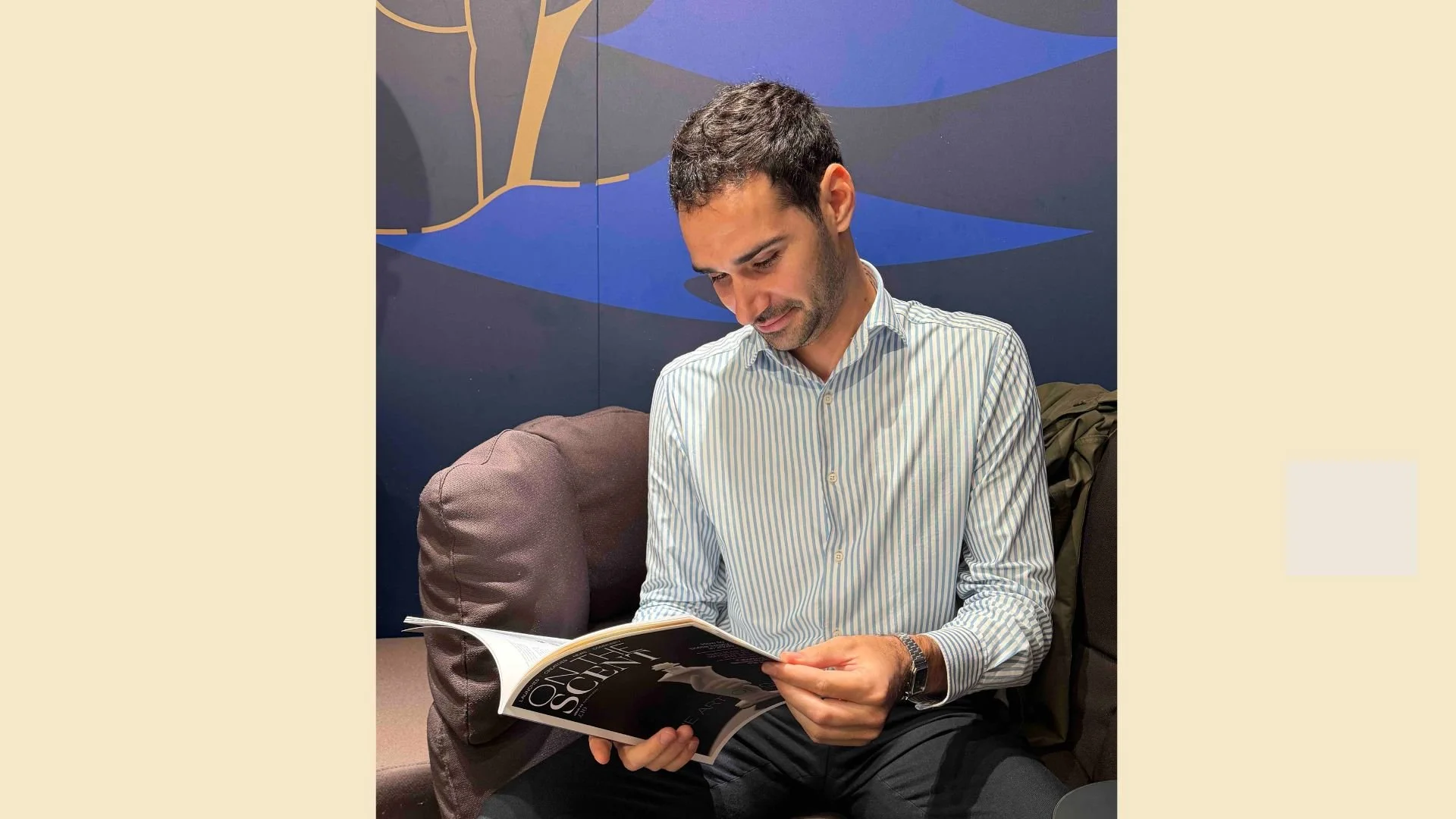
Matthieu Meneuvrier enjoying his copy of On The Scent magazine at our meeting
We met Matthieu Meneuvrier at the recent IFRA conference, and were immediately taken with the story of this rising star perfumer, who created acclaimed fragrances including Iris Nebula for Nancy Meiland, and Grossmith King’s Salute, which was launched on Coronation Day. Yet he never planned to be a perfumer…
Matthieu’s family, he explains, was involved in the production of essential oils, ‘so aromatic materials were part of my life from a very early age. They shaped my upbringing and my knowledge, but they did not immediately awaken a passion. That changed when I met a perfumer. I discovered that this profession existed and began to understand what it involved. Suddenly, I could see a way to turn my family background and my own experiences into something creative. There was something both mysterious and artistic about it that made me want to explore it further…’
Without the necessary qualifications in chemistry or biology to follow the traditional path to perfumery school, Matthieu devotedly set about obtaining those, before joining Robertet on an internship. After a meeting with Michel Almairac, the renowned perfumer offered him an apprenticeship – almost a golden ticket, in scent circles, and enough of an incentive for Matthieu to turn down a place at ISIPCA.
Matthieu now lives in London, dividing his time between working for Keva – a major Indian fragrance house which has now opened an office in Manchester – and his own Maison Matthieu Meneuvrier, where he has debuted two fragrances as the start of a planned collection.
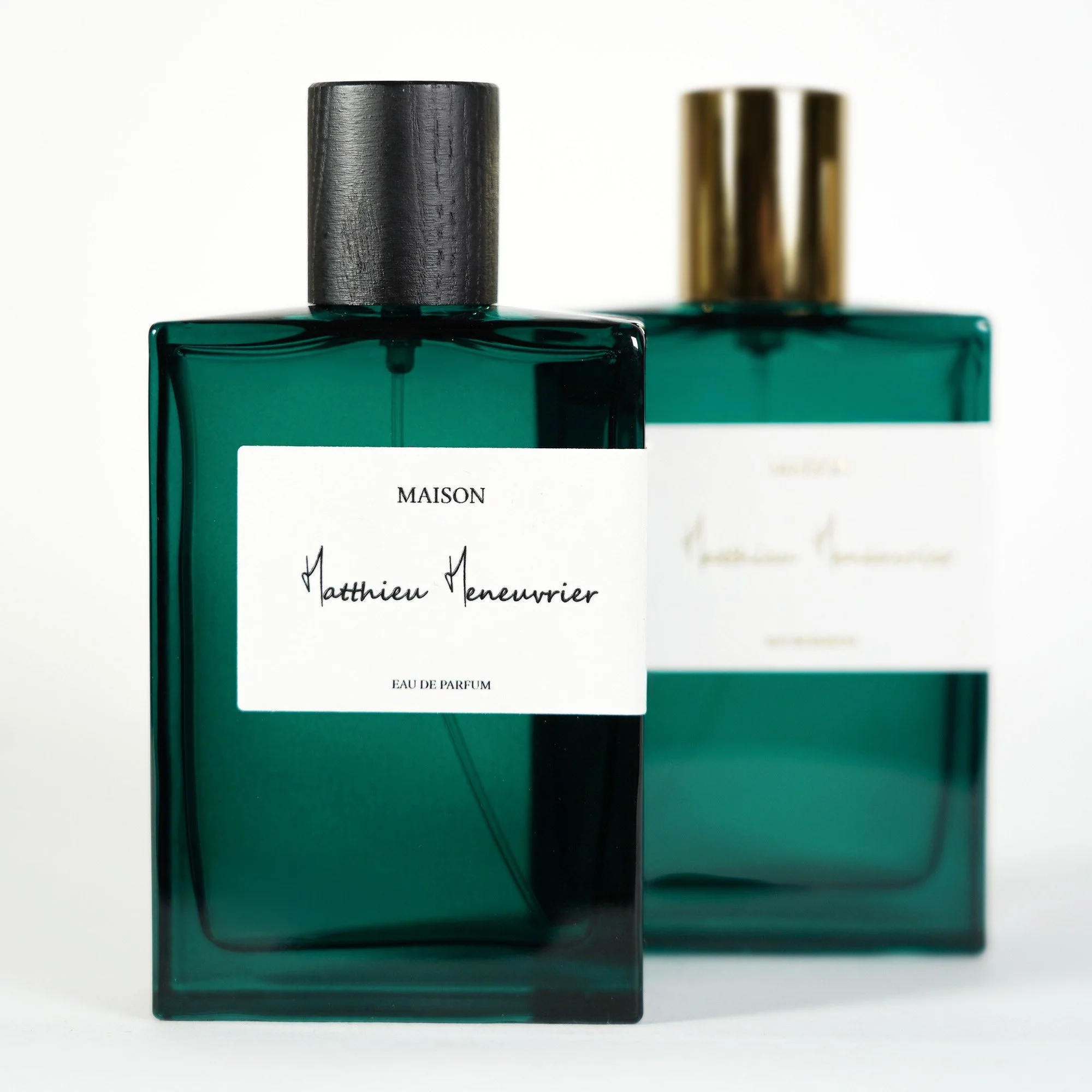
Maison Matthieu Meneuvrier’s debut fragrances
When does your day start?
My day begins a few seconds after I turn off my alarm. There are usually already messages waiting on my phone, so I find myself drawn into conversations and projects almost immediately.
Where do you work?
I chose to make London my home and set up an office here. I also recently joined Keva to support the creative team in Manchester, so when I am not travelling for the Maison, my working life takes me between the two cities.
For my own fragrance house, no two days are quite the same. Much of the work happens through my laptop or phone, alongside meetings with the people involved in every aspect of the business, from production and logistics to communication and distribution. Running a perfume house means being involved in everything that allows a fragrance to reach the person who will wear it.
At Keva in Manchester, my work centres on developing fragrances for local and global briefs. I work closely with colleagues across creation, evaluation, sales and marketing, as well as the compounding team.
How does your day break down?
I don’t really reserve creativity for a particular time of day. When an idea comes to me, I write it down straight away and try it as soon as I have the opportunity. I prefer to capture the thought while it is fresh.
How many fragrances might you be working on at one time?
A single brief can involve anything from one to four or five different directions. With several briefs running alongside one another, that quickly becomes quite a lot of fragrances. There is always something being developed, evaluated or reconsidered.
How do you compose fragrances?
Sometimes I like to begin by hand, sketching a triangle and writing down my ideas for the formula. Most of the time, though, I write directly on the computer, particularly when I already have a clear structure in mind. The idea begins in my head, but putting it into a formula allows me to explore it properly.
What kind of other inspirations do you look for during your day?
I often think about dressing someone with fragrance. I might look at a person and ask myself what perfume would suit them, what they are wearing and the feeling of the season. Nature and tailoring are important to me, but I am curious about many things. I enjoy attending different kinds of events and meeting people. Those encounters all feed into my work.
Travel matters too, although lately I have found myself more drawn to quieter places where I can feel relaxed and peaceful, with fewer people around. I used to make a conscious effort to seek out new experiences. Now, inspiration feels much more woven into everyday life. A conversation or an unexpected encounter can be enough. The challenge sometimes is finding a day when my mind can think about something else and rest.
“‘I often think about dressing someone with fragrance. I might look at a person and ask myself what perfume would suit them, what they are wearing... ‘”
Do you break for lunch?
I don’t have a fixed routine. I try to make healthy choices, both in what I eat and in the company I keep. I think conversations and thoughts can nourish you too, so I pay attention to what I take in beyond the food itself.
What will the afternoon be spent on?
The afternoon depends on the projects I am working on. It might involve creating, discussing a brief or moving things forward for the Maison. I become very absorbed in what I do, so I don’t always experience it as ‘work’. I try to head home around seven in the evening. Occasionally, I have a business meeting afterwards, although I try to keep those within the working day.
When you get home, is that the end of the working day?
Fragrance is part of who I am, so the thinking does not necessarily stop when I get home. A conversation with someone close to me might suddenly give me an idea for an accord. The people around me are curious about what I do, and I am equally interested in their worlds. Those exchanges naturally feed into my thoughts and ideas.
“’Fragrance is part of who I am, so the thinking doesn’t necessarily stop when I get home’”
Do you need to be in a particular mood to create?
That is a good question, and something I would like to pay more attention to! I am naturally quite a positive person. If something is bothering me, I tend to find it harder to create. Feeling relaxed and at ease seems to give me more room to explore an idea.
Tell us how you came to set up your own perfume house and what its vision is…
Having my own perfume house was always in the back of my mind. The question was when I would feel ready. That moment came when I had gained experience and confidence in my work as a perfumer. I had also learned a great deal from people around me with experience in other fields. Their knowledge, encouragement and support helped me feel ready to begin.
Maison Matthieu Meneuvrier is my personal creative space as a perfumer. Each fragrance expresses a different facet of a shared, recognisable signature. My vision is to make fragrance the final touch of an outfit. I am building a fragrance wardrobe inspired by the feelings of the seasons, with two interpretations of each season. You can wear those feelings whenever they call to you, whatever the time of year.
The book-shaped packaging is part of that idea. It is designed to be kept, collected and displayed alongside books and records, allowing the wardrobe to grow with each new creation.
How long does it take from concept to finished fragrance, in general?
For my own house, a fragrance can sometimes come together in relatively few trials, especially when I have a clear idea of what I want.
I share the trials with people close to me and pay attention to the attachment they develop to them. When someone keeps wanting to wear a fragrance and comes back asking for more, that means a great deal to me.
At Keva, the process depends on the customer’s brief and feedback. Sometimes a direction feels right very quickly; sometimes it needs more development. There is no single timeline that applies to every project.
Do you listen to music when you work?
I used to, but these days I prefer a calm, quiet environment.
Is a moodboard helpful to you?
“‘For my own house, a fragrance can sometimes come together in relatively few trials, especially when I have a clear idea of what I want’”
Very much so. I am a visual person, and moodboards played an important role in developing the identity of my house. Sometimes I begin with a moodboard to help define the feeling I want to express. At other times, I create the fragrance first and build the moodboard afterwards, to explore where it belongs within my universe.
How many materials do you have at your fingertips, to work with? And how many tend to be in your regular palette?
I have never really counted them, but I have always worked with extensive palettes. That was the case at Robertet, and it is also true at Keva. Working within large international fragrance houses has given me access to a very broad range of raw materials, so I am used to having plenty to explore.
Within that, I have favourite ingredients and particular qualities that I am especially fond of. My regular palette evolves with me: I find myself drawn to different materials from one season to another, and from year to year.
How much of your time is spent on your own work – creating new accords, working with new materials?
I like to sit down once a week and think about what the next fragrances could be. It gives me space to explore ideas beyond the projects already in progress and consider what I would like to develop next.
What is the one fragrance you wish you had created?
It is difficult to choose just one. Boss Bottled, Chloé, Terre d’Hermès and Baccarat Rouge 540 would all be on my list.
Find Matthieu’s debut fragrances, Jardin Interdit and Douce Insolence, at maisonmatthieumeneuvrier.co.uk